The story behind the name
Cher Ami, 1918
A homing pigeon, a trapped battalion and one last message. Here’s what history records, and why we named a private messenger after him.
“Dear friend”
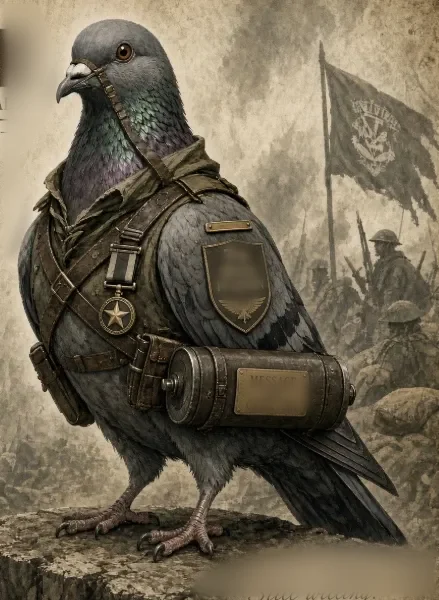
Cher Ami is French for “dear friend”. He was one of the homing pigeons the U.S. Army Signal Corps used in France during the First World War, when a bird could get a message through where wires and runners could not.
The flight
01 Under fire over the Argonne
What happened
Autumn 1918
In the Argonne Forest
Cher Ami flew from Mobile Loft No. 11, one of the Signal Corps lofts supporting the American 77th Division in the Meuse-Argonne offensive in France.
October 2, 1918
The Lost Battalion
Major Charles W. Whittlesey and several hundred men pushed ahead and were cut off and surrounded in the forest. Pigeons were their only way to reach headquarters.
October 4, 1918
Shelled by their own side
American artillery, not knowing where they were, began falling on the battalion. As the Smithsonian tells it, legend has it that Cher Ami was the last pigeon they had left. The message asked for the shelling to stop and gave their position.
The same afternoon
Shot, and still flying
Cher Ami was hit by enemy fire, wounded in the breast and the leg, and still made it back to his loft, with the message capsule hanging from the injured leg.
October 7, 1918
Relief
By the time he landed the barrage had stopped, but the position he carried helped the relief force reach the battalion. About 194 men walked out.
After the war
A lost leg and a medal
Army medics saved his life but not his right leg, which ended his service. France awarded him the Croix de Guerre with palm.
1919
Home
He arrived in the United States on April 16, 1919, to great acclaim, and lived at Camp Alfred Vail (now Fort Monmouth), New Jersey. He died of his wounds on June 13, 1919.
Since 1921
On display
Preserved and given to the Smithsonian, he has been on display since 1921, today at the National Museum of American History in Washington, D.C. In 1931 he entered the Racing Pigeon Hall of Fame.
A century later
A surprise
Army records listed Cher Ami as a hen. DNA testing at the Smithsonian showed he was male.
Why we named the app after him
A message in a sealed capsule, carried by a small, stubborn messenger from one loft to another. That’s still the idea.
Lofts
Pigeons fly home to lofts. Our network runs on Lofts too: small programs people run on their own computers, carrying sealed messages along.
Sealed
The capsule was only for the people it was meant for. Cher Ami messages are end-to-end encrypted, so only the people you write to can open them.
Dear friend
It’s an app for the people you care about. No ads, no phone number, and your contacts stay on your phone.
A note on history
Accounts of 1918 differ on some details, like how many men were trapped and exactly which messages Cher Ami carried. We follow the Smithsonian’s account and keep its “legend has it” where it uses one. The portrait on this page is an illustration.